
http://www.sciencedirect.com/science/article/pii/S0168365909007111
In this week's lecture, we learned about Nanotechnology and Art. Nanotechnology is technology, science, and engineering at the nanoscale, which isn't visible to the naked eye.
I came across an article that talks about Nanotechnology to improve human diagnostics and therapeutics. These therapeutic products are based on ultra-adaptable, self-regulating, nano-sized characters that are supposed to allow certain drugs to enter your body through your skin.The challenge of perfecting such a hard task is due to the complex barrier of our skin. Our skin is the art being worked out on by the science of nanotechnology.The article goes in detail on what it would take in order for this to actually take place and it's very complicated.

A picture form the article
https://source.wustl.edu/2011/02/new-nanoparticles-make-blood-clots-visible/
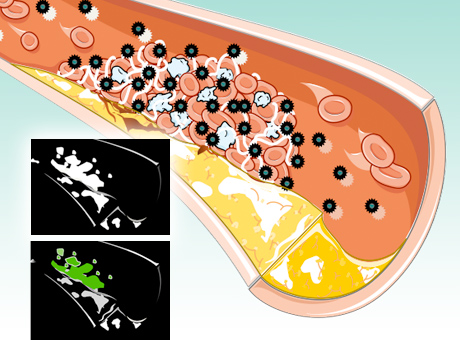
I felt the article titled " New nanoparticles make blood clots visible" also was a great example of this weeks' topic. Researchers at Washington University of Medicine in St Louis have designed nanoparticles that find clots and make them visible on a new x-ray technology. The number of people who walk into hospitals every year for chest pain is in the millions and most of this people aren't treated correctly. This new technology will be able to locate heart attacks before they happen and this new scanner will be able to show a blood clot's exact location. This new technology is vital and if successful, will be able to save millions of lives.
Evangelou Strait, Julia. "New Nanoparticles Make Blood Clots Visible | The Source | Washington University in St. Louis." The Source. Washington University in St. Loiuis, 02 Feb. 2011. Web. 22 May 2016.
, Gregor, and Ulrich Vierl. "Nanotechnology and the transdermal route: a state of the art review and critical appraisal." Journal of Controlled Release141.3 (2010): 277-299.
Simberg, Dmitri, et al. "Biomimetic amplification of nanoparticle homing to tumors." Proceedings of the National Academy of Sciences 104.3 (2007): 932-936.

No comments:
Post a Comment